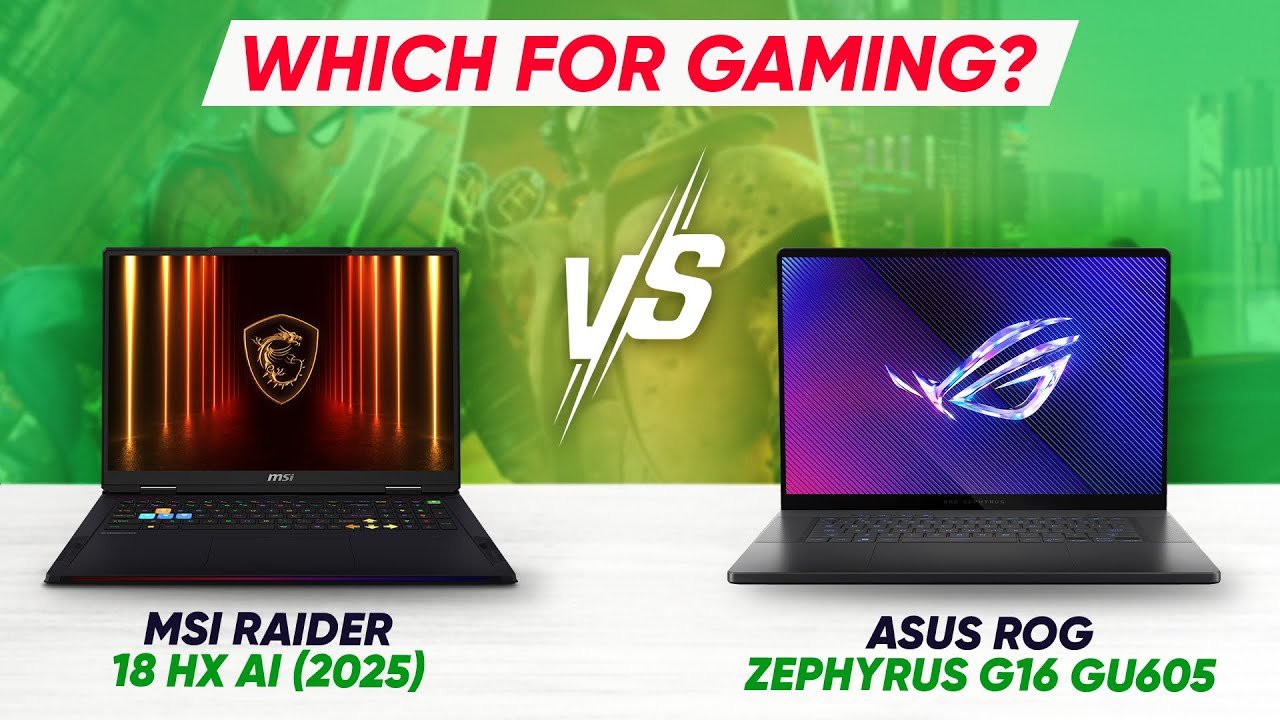
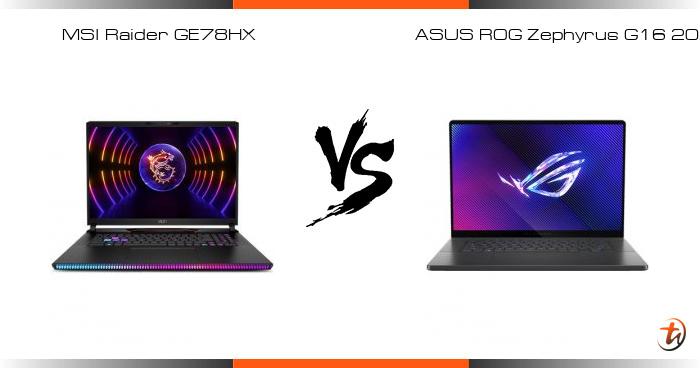
Clash of Titans: ROG Zephyrus G16 vs. MSI Raider GE78 – A Head-to-Head Battle for Gaming Supremacy
The world of high-performance gaming laptops is a battlefield where innovation clashes with raw power, and portability vies for supremacy with uncompromising thermal solutions. In this arena, two formidable contenders stand out, each appealing to a distinct segment of the demanding gaming community: the sleek, sophisticated ASUS ROG Zephyrus G16 and the robust, unyielding MSI Raider GE78. Both machines represent the pinnacle of modern laptop engineering, packing desktop-grade components into their respective chassis. However, their philosophies and target audiences diverge significantly, making a direct head-to-head comparison essential for anyone looking to invest in a premium gaming rig.
This in-depth article will dissect every critical aspect of the ROG Zephyrus G16 and the MSI Raider GE78, examining their design, display, performance, cooling, keyboard, connectivity, battery life, and overall value proposition. By the end, you’ll have a clear understanding of which titan is best suited to conquer your specific gaming and productivity needs.
1. Design and Aesthetics: Elegance vs. Aggression
The first impression is often the most lasting, and here, the Zephyrus G16 and Raider GE78 present two starkly contrasting visions.
ROG Zephyrus G16: ASUS has consistently pushed the envelope for sleek, minimalist gaming aesthetics with its Zephyrus line, and the G16 is no exception. It embodies a refined, professional look that belies its gaming prowess. Crafted from premium materials like magnesium-aluminum alloy, the chassis feels robust yet remarkably light for a 16-inch gaming laptop. Its thinner profile and lighter weight (often starting around 1.9-2.2 kg, depending on configuration) make it significantly more portable than many of its peers. The design often features subtle accents, such as the distinctive Slash Lighting or customizable AniMe Matrix on the lid of some models, adding a touch of personality without screaming "gamer." The overall aesthetic allows the G16 to blend seamlessly into a professional office environment or a university lecture hall, then transform into a powerful gaming machine at home.
MSI Raider GE78: In stark contrast, the MSI Raider GE78 makes no apologies for its bold, aggressive, and undeniably "gamer" aesthetic. It’s a statement piece, built for those who want their laptop to exude power and performance. The chassis is thicker and heavier (typically ranging from 2.8-3.1 kg), accommodating its more robust cooling system and larger battery. MSI’s signature Mystic Light bar, a customizable RGB strip running across the front edge, is a prominent feature, along with per-key RGB lighting on the keyboard. The angular lines, prominent vents, and substantial build quality convey a sense of unadulterated power. The GE78 is designed to be noticed, to sit proudly as a desktop replacement, and to project an aura of gaming dominance.
Verdict: The choice here is purely subjective. If you value portability, subtlety, and a design that can transition between work and play with ease, the Zephyrus G16 is your champion. If you prioritize raw, unashamed gamer aesthetics, robust build, and are less concerned with weight or blending in, the Raider GE78 is the clear winner.
2. Display: Visual Fidelity for Every Vision
Both laptops offer cutting-edge displays, but their primary focus can differ, catering to distinct user priorities.
ROG Zephyrus G16: The G16 often comes equipped with stunning display options that appeal to both gamers and content creators. ASUS frequently utilizes high-resolution (QHD+ or even 2.5K), high refresh rate (165Hz to 240Hz) panels, often with OLED technology or their proprietary ROG Nebula HDR Mini LED displays. These panels boast incredible color accuracy (100% DCI-P3 coverage), exceptional contrast ratios (especially OLED), deep blacks, and blazing-fast response times (as low as 0.2ms for OLED). This makes the G16 an excellent choice not just for immersive gaming but also for professional tasks like video editing, graphic design, and photo manipulation where color precision is paramount. NVIDIA G-Sync or Adaptive Sync support ensures tear-free gaming.
MSI Raider GE78: The GE78, while also offering excellent display options, typically leans more heavily into pure gaming performance. You’ll find high-refresh-rate IPS panels, commonly 17-inch QHD+ (2560×1600) with refresh rates of 240Hz, 360Hz, or even higher, prioritizing buttery-smooth gameplay. While these IPS panels offer good color accuracy and brightness, they might not reach the same levels of contrast or color vibrancy as the OLED or Mini LED options found in some G16 configurations. The focus here is on providing the fastest, most responsive visual experience for competitive gaming, minimizing input lag and motion blur. G-Sync is standard, ensuring smooth frame delivery.
Verdict: For content creators and those who appreciate breathtaking visual fidelity, deep blacks, and vibrant colors in addition to gaming, the Zephyrus G16 with its OLED or Mini LED options often has an edge. For hardcore competitive gamers who demand the absolute fastest refresh rates and response times for maximum in-game advantage, the GE78’s high-Hz IPS panels are a fantastic choice.
3. Performance: The Heart of the Battle
This is where the true differences in philosophy become most apparent. Both machines house top-tier components, but their ability to sustain peak performance varies significantly due to their thermal designs.
CPU: Both laptops are equipped with the latest and greatest processors from Intel (e.g., 13th/14th Gen Core i9 HX series) or AMD (Ryzen 7000/8000 series). The GE78, with its more generous thermal headroom, can often allow its CPU to operate at higher sustained power limits (PL1/PL2), potentially delivering a marginal but noticeable performance advantage in CPU-intensive tasks like rendering, compiling, or complex simulations. The G16’s CPU performance is still excellent, but it’s optimized to run efficiently within its thinner chassis.
GPU: This is the primary differentiator. Both can be configured with NVIDIA’s most powerful laptop GPUs, ranging from the RTX 4070 up to the flagship RTX 4090. However, the crucial factor here is the Total Graphics Power (TGP).
- ROG Zephyrus G16: Due to its slim design, the G16 typically operates its GPUs at a slightly lower TGP ceiling. For instance, an RTX 4090 in a G16 might run at 120-140W (with Dynamic Boost), which is still incredibly powerful but not the absolute maximum. This means excellent performance for its size, but not the peak performance of the GPU.
- MSI Raider GE78: The GE78, with its robust cooling system and larger chassis, can push its GPUs to their absolute limits. An RTX 4090 in a GE78 will often run at its full 175W TGP (including Dynamic Boost), unlocking the GPU’s complete potential. This translates to higher sustained frame rates, better performance in demanding games at max settings, and faster rendering times in GPU-accelerated applications.
RAM and Storage: Both systems offer ample RAM (up to 32GB or 64GB DDR5) and fast NVMe PCIe Gen 4 SSDs (often configurable with dual M.2 slots for massive storage). Upgradeability is generally good on both, though the GE78 often provides easier access for DIY upgrades.
Gaming Benchmarks: In most demanding titles, especially at QHD+ resolution with high settings, the MSI Raider GE78 will consistently deliver 10-20% higher sustained frame rates compared to a similarly specced Zephyrus G16, particularly when both are equipped with the highest-tier GPUs. This gap widens during extended gaming sessions as the GE78’s superior cooling prevents thermal throttling more effectively.
Productivity/Content Creation: While the G16 is a fantastic machine for content creation, the GE78’s raw, sustained CPU and GPU power will give it an edge in heavy-duty tasks like 4K video editing, 3D rendering, and large-scale data processing. However, the G16’s potentially superior display for color accuracy might make it the preferred choice for visual artists or photographers.
Verdict: For the absolute best raw, sustained gaming performance and the highest possible frame rates, the MSI Raider GE78 is the undisputed champion. It leverages its larger chassis and cooling to unlock the full potential of its components. The ROG Zephyrus G16, however, offers exceptional performance for its form factor, making it a stellar choice for those who need a powerful machine without the bulk.
4. Cooling System: The Unsung Hero
The cooling system is arguably the most critical component differentiating these two laptops’ performance capabilities.
ROG Zephyrus G16: ASUS employs sophisticated cooling solutions in the G16, often featuring a vapor chamber, liquid metal thermal compound on the CPU (in some high-end configurations), multiple fans, and numerous heat pipes. The "Intelligent Cooling" philosophy aims to maximize performance within the confines of a thin chassis, dynamically adjusting fan speeds and power limits. While very effective for its size, the G16 will inevitably run hotter and potentially throttle sooner under prolonged heavy loads compared to the GE78. The fan noise can also become quite noticeable under peak stress.
MSI Raider GE78: The GE78 boasts a truly gargantuan cooling system. Its thicker chassis allows for a much larger heatsink array, often featuring two massive fans, multiple dedicated heat pipes for both CPU and GPU, and large exhaust vents. MSI’s "Cooler Boost 5" or "Cooler Boost Titan" technology is designed for maximum heat dissipation, enabling the components to run at their highest TGP for extended periods without significant thermal throttling. This superior cooling translates directly into higher sustained performance and greater stability during marathon gaming sessions. The trade-off is often increased fan noise, though the larger fans might move air more efficiently at lower RPMs than the smaller fans in the G16.
Verdict: The MSI Raider GE78 wins unequivocally in cooling performance. Its robust thermal solution allows for sustained maximum performance, which is a significant advantage for hardcore gamers and power users. The Zephyrus G16’s cooling is excellent for its thin profile, but it simply cannot defy the laws of physics as effectively as the GE78.
5. Keyboard and Trackpad: Input Experience
The interaction points are crucial for both gaming and productivity.
ROG Zephyrus G16: The G16 typically features a comfortable, well-spaced keyboard with good key travel and satisfying tactile feedback. It often includes per-key RGB lighting, though some models might offer zone lighting. The layout is generally standard, sometimes omitting a dedicated Numpad to keep the chassis compact, but offering a larger trackpad. The trackpad is usually large, precise, and supports Windows Precision drivers, making it excellent for navigation and gestures.
MSI Raider GE78: MSI partners with SteelSeries for its keyboards, and the GE78 benefits from this collaboration. The keyboard offers excellent key travel, a satisfyingly clicky or tactile response (depending on the specific switch design), and full per-key RGB customization via SteelSeries Engine. A full Numpad is almost always present. For many gamers, the SteelSeries keyboard is a highlight, offering a premium typing and gaming experience. The trackpad is also large and accurate, though some users might find the texture or click mechanism slightly different from ASUS’s offerings.
Verdict: Both offer excellent input experiences. For pure typing comfort and a potentially larger trackpad, the G16 is great. For dedicated gamers who appreciate the tactile feedback and extensive customization of a SteelSeries keyboard, the GE78 might have a slight edge.
6. Port Selection: Connectivity Options
A comprehensive port selection is vital for a versatile gaming setup.
ROG Zephyrus G16: The G16 offers a good array of modern ports, typically including USB-C with Thunderbolt 4 (on Intel models) or USB4 (on AMD models) with DisplayPort and power delivery, multiple USB-A ports, HDMI 2.1, a 3.5mm audio jack, and sometimes a microSD card reader. Gigabit Ethernet is usually present. The selection is well-rounded for most users, balancing utility with the thin chassis.
MSI Raider GE78: The GE78 generally provides a more extensive and robust port selection. In addition to similar USB-C (Thunderbolt 4/USB4) and USB-A ports, it often includes dedicated Mini-DisplayPort 1.4, a full-sized SD card reader, a more powerful HDMI 2.1 port, and sometimes even 2.5 Gigabit Ethernet. The sheer number and variety of ports make it a true desktop replacement, capable of connecting to multiple external monitors, a plethora of peripherals, and high-speed network connections without needing a dongle.
Verdict: The MSI Raider GE78 typically offers a more comprehensive and versatile port selection, making it the better choice for power users with numerous peripherals and external display needs.
7. Battery Life: Untethered Performance
Battery life is often a secondary concern for gaming laptops, but it can be crucial for portability.
ROG Zephyrus G16: Despite being a powerful gaming machine, the Zephyrus G16 often boasts surprisingly good battery life for its category. This is thanks to larger battery capacities (often 90Whr or more), efficient CPUs, MUX switches (allowing the discrete GPU to be fully disabled), and optimized power management. Users can often expect 6-8 hours of light productivity or web browsing, making it genuinely portable for day-to-day tasks.
MSI Raider GE78: While the GE78 also packs a large battery (often 99.9Whr, the largest allowed on flights), its sheer power and less aggressive focus on power efficiency mean its battery life is generally shorter than the G16. Expect around 3-5 hours of light use. It’s designed primarily to be plugged in for optimal performance.
Verdict: The ROG Zephyrus G16 offers significantly better battery life, making it the more practical choice for users who need to work or game on the go without constant access to a power outlet.
8. Audio and Software: Immersive Experiences and Control
Audio:
- ROG Zephyrus G16: Features a multi-speaker setup (often 6 speakers with force-canceling woofers) with Dolby Atmos support, delivering rich, immersive audio with good bass and clear highs.
- MSI Raider GE78: Often boasts a Dynaudio-tuned sound system with larger speakers and sometimes a dedicated subwoofer, providing a powerful and detailed audio experience, often with a slightly more pronounced bass response.
Both provide excellent audio for gaming and media consumption, often surpassing other laptop categories.
Software:
- ROG Zephyrus G16: Utilizes ROG Armoury Crate for system monitoring, performance profiles (Silent, Performance, Turbo, Manual), fan control, and RGB customization.
- MSI Raider GE78: Employs MSI Center, offering similar functionalities for performance modes, fan control, Mystic Light customization, and system diagnostics.
Both software suites are generally robust, though they can sometimes be perceived as a bit heavy or come with minor bloatware. They are essential for unlocking and managing the full potential of each laptop.
9. Price and Value: Investing in Power
Both the ROG Zephyrus G16 and the MSI Raider GE78 occupy the premium segment of the gaming laptop market, with prices varying significantly based on configuration, region, and sales.
- ROG Zephyrus G16: Generally starts at a slightly lower price point for base configurations but can quickly climb into the high-end with OLED/Mini LED displays and top-tier GPUs. Its value proposition lies in its balance of performance, portability, and premium design.
- MSI Raider GE78: Often commands a higher price tag for equivalent CPU/GPU configurations, primarily due to its more elaborate cooling system, robust chassis, and comprehensive port selection. Its value is in delivering the absolute maximum performance and a desktop-replacement experience.
Verdict: If your budget is tighter but you still demand high performance and premium features in a portable package, the G16 might offer better value. If your budget allows for the absolute top-tier performance and you view the laptop as a primary gaming rig or desktop replacement, the GE78 justifies its higher cost through unparalleled power delivery.
Who is it For?
Choose the ROG Zephyrus G16 if:
- You prioritize portability, a slim profile, and a sophisticated, professional aesthetic.
- You are a content creator (video editor, graphic designer) who also games and values a high-quality, color-accurate display (especially OLED/Mini LED options).
- You need decent battery life for work or study on the go.
- You want excellent gaming performance but don’t need the absolute bleeding edge of sustained FPS at maximum TGP.
- You appreciate a premium build quality and a comfortable, ergonomic experience.
Choose the MSI Raider GE78 if:
- You are a hardcore gamer who demands the absolute highest sustained frame rates and doesn’t want to compromise on performance.
- You need a true desktop replacement and are less concerned with portability or battery life.
- You value a robust, aggressive "gamer" aesthetic with extensive RGB lighting.
- You perform CPU-intensive tasks like rendering or heavy multi-tasking where maximum sustained power is critical.
- You appreciate a comprehensive port selection for multiple peripherals and external displays.
- You prioritize the most effective cooling system available in a laptop to ensure components run at their peak.
Conclusion
The ROG Zephyrus G16 and the MSI Raider GE78 are both magnificent examples of modern gaming laptop engineering, each excelling in different aspects. There is no single "better" laptop; rather, there is a better laptop for you.
The ROG Zephyrus G16 is the agile, stylish warrior – a premium blend of power, portability, and elegance. It caters to the gamer who also needs a capable machine for professional work, someone who values a harmonious balance and doesn’t want to sacrifice style for substance. It’s for the individual who moves between different environments and needs a laptop that can adapt seamlessly.
The MSI Raider GE78 is the unyielding, powerhouse tank – a no-compromise desktop replacement built for maximum performance and thermal endurance. It’s for the dedicated gamer, the power user, or the enthusiast who wants to extract every last frame and every ounce of processing power, and for whom raw strength and sustained dominance are paramount.
Ultimately, your decision will come down to your personal priorities, lifestyle, and budget. Assess what truly matters most to you in a high-end gaming laptop, and you’ll find your champion among these two formidable titans.