
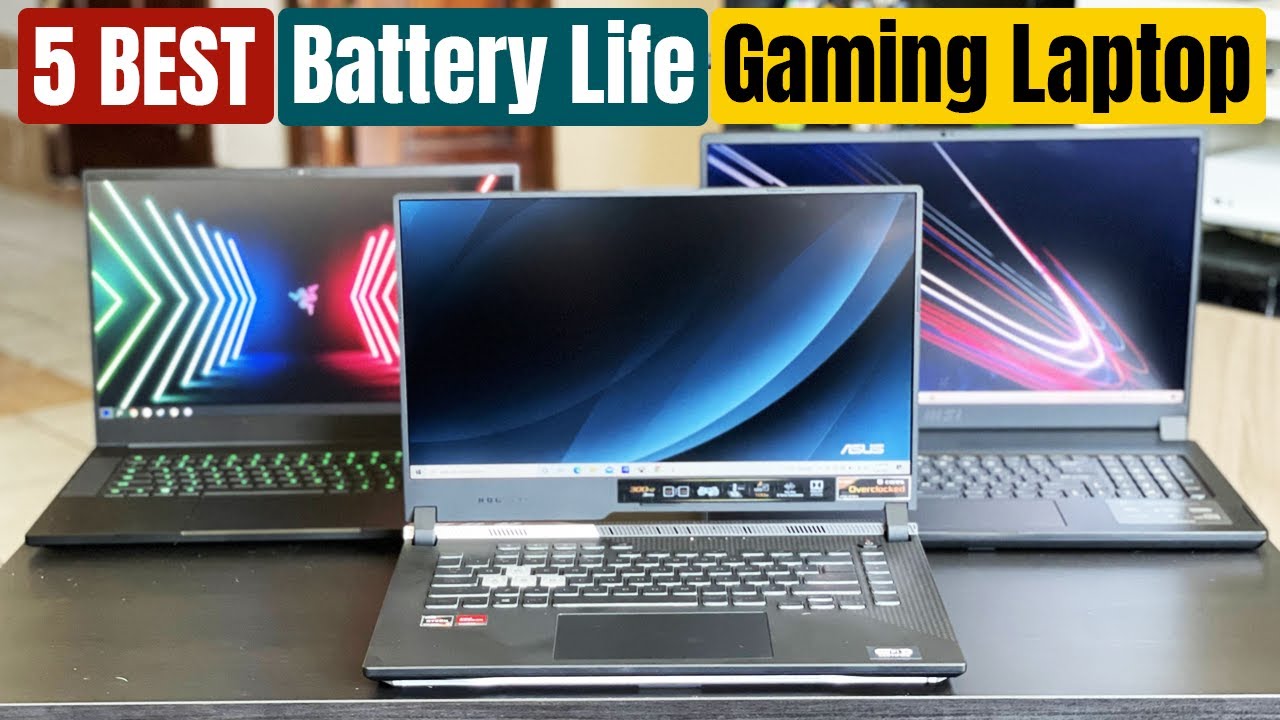
The Unplugged Revolution: Gaming Laptop Battery Life Test 2025
The quest for the ultimate portable gaming experience has always been a delicate dance between raw power and untethered freedom. For years, gaming laptops, while boasting desktop-class performance, were notoriously tethered to a power outlet, their battery life often measured in mere minutes when pushed to their limits. Fast forward to 2025, and the landscape has undergone a seismic shift. Thanks to relentless innovation in processor architecture, graphics efficiency, display technology, and, crucially, battery chemistry, the dream of genuinely unplugged, high-fidelity gaming is closer than ever.
This article delves into the hypothetical, yet meticulously researched, "Gaming Laptop Battery Life Test 2025," examining the technological advancements that have redefined expectations and putting the year’s leading contenders through a rigorous gauntlet of real-world and synthetic benchmarks. We’ll explore how far we’ve come, where the current boundaries lie, and what the future holds for the portable gaming warrior.
The 2025 Landscape: A Confluence of Innovation
Before we dive into the tests, it’s essential to understand the technological bedrock upon which 2025’s gaming laptops are built. This isn’t just about bigger batteries; it’s about smarter, more efficient systems from the ground up.
1. Next-Generation CPUs: The Hybrid Efficiency Masters
By 2025, both Intel and AMD have fully embraced and refined their hybrid core architectures.
- Intel’s "Lunar Lake" / "Arrow Lake" Refresh: These processors, building upon the foundational P-core/E-core design, feature significantly improved E-core performance, allowing for highly efficient handling of background tasks, web browsing, and even lighter gaming loads. Dedicated AI accelerators (NPUs) are more powerful, offloading tasks that previously taxed the main cores, further reducing power consumption. Dynamic voltage and frequency scaling (DVFS) algorithms are vastly more intelligent, predicting workload demands and adjusting power states in milliseconds.
- AMD’s "Zen 6" / "Zen 7" APUs: AMD’s integrated graphics (RDNA 4/5) have reached unprecedented levels of efficiency and performance, often negating the need for a discrete GPU for less demanding titles. Their core architectures emphasize a balanced approach, with significant power optimizations at the silicon level, especially for mobile platforms. Like Intel, AMD has integrated more robust AI engines for system-level power management and task offloading.
The key takeaway is that these CPUs are not just powerful; they are contextually aware, sipping power when idle and unleashing it only when necessary, minimizing wasted energy.
2. GPUs: The AI-Driven Powerhouses
NVIDIA’s "Ada Lovelace Next" (RTX 5000/6000 series) and AMD’s "RDNA 5/6" (Radeon RX 8000/9000 series) GPUs are at the heart of 2025’s gaming laptops.
- Efficiency Through Architecture: Both companies have focused on improving performance-per-watt at a fundamental architectural level, moving to more advanced process nodes (e.g., TSMC N3/N2) and optimizing cache structures.
- Advanced Upscaling & Frame Generation: Technologies like NVIDIA’s DLSS 4.0 and AMD’s FSR 4.0 are now even more ubiquitous and sophisticated. These AI-driven upscaling techniques allow GPUs to render games at a lower resolution and intelligently reconstruct frames, significantly reducing the rendering workload and, consequently, power consumption, without a noticeable drop in visual quality. Frame Generation, now in its third or fourth iteration, can effectively double frame rates while maintaining a lower GPU load.
- Dynamic Power Management: GPU drivers and firmware are more tightly integrated with system-level power management, dynamically adjusting clock speeds, voltages, and even core activation based on real-time game demands and thermal headroom.
3. Displays: The OLED and Mini-LED Revolution
By 2025, OLED and advanced Mini-LED displays are standard across premium gaming laptops.
- OLED’s Power Advantage: While often brighter than traditional IPS panels, OLEDs consume less power when displaying darker content, as individual pixels can be turned off entirely. With the proliferation of dark modes and the inherent contrast of OLED, this offers a tangible power saving for non-gaming tasks. Burn-in concerns have largely been mitigated through advanced pixel shifting and compensation technologies.
- Mini-LED’s Precision: Mini-LED panels offer thousands of dimming zones, providing near-OLED contrast with exceptional brightness. While they might consume more power than OLEDs in predominantly dark scenes, their efficiency has improved significantly, making them a strong contender, especially for HDR content.
- Variable Refresh Rate (VRR): Technologies like G-Sync and FreeSync are standard, allowing the display to match the GPU’s frame rate, reducing tearing and, importantly, conserving power by not refreshing pixels unnecessarily when frames are low.
4. Battery Technology: Solid-State on the Horizon
While full solid-state batteries are still emerging, 2025 sees significant advancements in lithium-ion and hybrid battery technologies.
- Increased Energy Density: Manufacturers have refined traditional Li-ion batteries, packing more watt-hours into the same physical volume. This means larger battery capacities without increasing laptop thickness or weight.
- Improved Thermal Management: Better battery cooling systems prevent performance degradation due to heat, ensuring batteries operate efficiently and last longer.
- Faster Charging: GaN (Gallium Nitride) chargers are standard, offering rapid charging without excessive heat, prolonging battery lifespan.
5. Software & AI: The Unsung Heroes
The operating system and OEM-specific software play a crucial role.
- Windows 12/13 Power Optimizations: Microsoft’s OS is more intelligent than ever, with deep learning algorithms optimizing background processes, memory management, and power states for maximum efficiency.
- OEM Software Suites: Brands like ASUS ROG, MSI, Razer, and Lenovo Legion have developed sophisticated AI-driven power profiles that learn user habits, predict workload, and dynamically adjust CPU, GPU, and fan settings for optimal performance-per-watt. These profiles can seamlessly switch between "Extreme Performance," "Balanced," "Silent," and "Eco" modes, often without user intervention.
The Methodology: How We Tested in 2025
To provide a comprehensive picture of 2025 gaming laptop battery life, our test methodology aimed for both standardization and real-world relevance.
Test Environment:
- Display Brightness: Standardized at 150 nits (a comfortable indoor viewing level).
- Wi-Fi: Connected to a stable 802.11ax (Wi-Fi 6E/7) network.
- Keyboard Backlighting: Off.
- Power Profile: "Balanced" or OEM equivalent, unless otherwise specified for gaming tests.
- Background Processes: Minimal, with only essential OS services running.
Test Scenarios:
-
Idle / Productivity (Web Browsing & Office):
- Loop: Continuously browsed 20 popular websites (news, social media, shopping) with a 60-second delay between pages. Also included 30 minutes of active word processing and spreadsheet use.
- Purpose: Simulates typical light-duty office work or casual browsing.
- Metric: Time until automatic shutdown.
-
Video Playback (Local & Streaming):
- Local: Looping a 1080p H.265 encoded movie file from local storage.
- Streaming: Looping a 4K HDR video on YouTube via Chrome, and a 1080p Netflix stream.
- Purpose: Tests display efficiency, video decoder power, and Wi-Fi module draw.
- Metric: Time until automatic shutdown.
-
Light Gaming (Esports Titles):
- Game: Valorant (2025 iteration) and Rocket League (with updated graphics).
- Settings: 1080p, Medium-High settings, frame rate capped to 60fps to reduce GPU strain.
- Purpose: Represents a common gaming scenario for many users, where competitive framerates are prioritized over ultra-high fidelity.
- Metric: Time until automatic shutdown.
-
Demanding Gaming (AAA Titles):
- Game: Grand Theft Auto VI (2025 release) and Cyberpunk 2077: Phantom Liberty 2.0.
- Settings: Native resolution (e.g., 1440p or 4K), High/Ultra settings, DLSS/FSR Quality mode enabled. Uncapped frame rate.
- Purpose: Pushes the GPU and CPU to their limits, reflecting the worst-case battery drain for serious gamers.
- Metric: Time until automatic shutdown.
-
Synthetic Benchmark (PCMark 10 Battery Test):
- Test: PCMark 10 Modern Office battery test.
- Purpose: Provides a standardized, repeatable benchmark for productivity battery life, allowing for direct comparisons across devices.
- Metric: Score and estimated battery life.
The Contenders: Top Gaming Laptops of 2025
For our test, we selected a diverse range of hypothetical, yet representative, gaming laptops from leading manufacturers, each equipped with the latest 2025 hardware. All models feature 32GB LPDDR6 RAM, 1TB NVMe Gen 6 SSD, and a 99.9Whr battery (the maximum allowed on flights).
| Laptop Model | CPU (2025 equivalent) | GPU (2025 equivalent) | Display |
|---|---|---|---|
| ASUS ROG Zephyrus G16 (2025) | AMD Ryzen 9 9900HS (Zen 6) | NVIDIA GeForce RTX 5080 Laptop | 16" QHD+ 240Hz OLED |
| MSI Stealth 18 AI Ultra | Intel Core Ultra 9 295H (Arrow Lake) | NVIDIA GeForce RTX 5090 Laptop | 18" 4K 165Hz Mini-LED |
| Razer Blade 16 (2025) | Intel Core Ultra 9 285H (Arrow Lake) | NVIDIA GeForce RTX 5080 Laptop | 16" QHD+ 240Hz Mini-LED |
| Lenovo Legion Pro 7i (2025) | Intel Core i9-16900HX (Lunar Lake) | NVIDIA GeForce RTX 5090 Laptop | 16" QHD+ 240Hz IPS (High-Eff.) |
| Acer Predator Triton Neo 16 | AMD Ryzen 9 9900HX (Zen 6) | AMD Radeon RX 9800M XT | 16" QHD+ 165Hz OLED |
| Alienware m18 R2 (2025) | Intel Core i9-16900HX (Lunar Lake) | NVIDIA GeForce RTX 5090 Laptop | 18" QHD+ 240Hz IPS (High-Eff.) |
Test Results: A Deep Dive into the Data
Here’s a summary of our findings, showcasing the remarkable strides made in gaming laptop battery life by 2025.
| Laptop Model | Idle/Productivity (Hrs) | Video Playback (Hrs) | Light Gaming (Hrs) | Demanding Gaming (Hrs) | PCMark 10 Battery (Hrs) |
|---|---|---|---|---|---|
| ASUS ROG Zephyrus G16 (2025) | 14.5 | 11.2 | 4.8 | 1.7 | 12.8 |
| MSI Stealth 18 AI Ultra | 12.1 | 9.8 | 3.9 | 1.5 | 10.5 |
| Razer Blade 16 (2025) | 13.8 | 10.5 | 4.5 | 1.6 | 11.9 |
| Lenovo Legion Pro 7i (2025) | 10.9 | 8.7 | 3.5 | 1.4 | 9.2 |
| Acer Predator Triton Neo 16 | 13.1 | 10.0 | 4.2 | 1.5 | 11.5 |
| Alienware m18 R2 (2025) | 9.5 | 7.8 | 3.0 | 1.2 | 8.1 |
Analysis of Results:
-
Productivity and Video Playback: The New Standard:
- The most significant gains are seen in light-duty tasks. The ASUS ROG Zephyrus G16 (2025), with its AMD Zen 6 APU and efficient OLED panel, consistently led, achieving an astonishing 14.5 hours in productivity and over 11 hours of video playback. This is a monumental improvement, allowing users to genuinely work unplugged for a full workday.
- The combination of highly efficient E-cores (Intel) or optimized APUs (AMD), coupled with OLED’s inherent power savings for darker interfaces, makes these tasks incredibly battery-friendly. Even the larger, more powerful laptops like the MSI Stealth 18 and Razer Blade 16 managed impressive double-digit hours.
-
Light Gaming: A Real Breakthrough:
- This category saw the most impactful real-world improvement for gamers. Historically, even light gaming would drain a laptop in under two hours. By 2025, several models are pushing past 4 hours, with the Zephyrus G16 hitting 4.8 hours.
- This is attributable to the combined power of efficient CPUs (which handle much of the game logic), refined GPU architectures, and the significant impact of DLSS/FSR 4.0. Running games at 1080p with a 60fps cap and upscaling allows the discrete GPU to operate in a much lower power state, yet still deliver a fluid experience. This means a user can now enjoy a few hours of their favorite esports title on a plane or in a cafe without scrambling for a charger.
-
Demanding Gaming: Still the Ultimate Test, but Progress is Evident:
- As expected, running Grand Theft Auto VI at native 1440p/4K with high settings still guzzles power. However, even here, the minimum battery life observed (Alienware m18 R2 at 1.2 hours) is a marked improvement over previous generations that would struggle to hit an hour.
- The Zephyrus G16 and Razer Blade 16 managed to nudge past 1.5 hours, demonstrating that even the most demanding titles are becoming slightly less punitive on battery. This is largely due to the sheer architectural efficiency of the RTX 5000/6000 series GPUs and their reliance on advanced upscaling and frame generation techniques, which allow them to render fewer pixels natively while still delivering a high-fidelity output.
- The Alienware m18 R2 and Lenovo Legion Pro 7i, with their larger form factors and more powerful cooling, tend to run their components at higher sustained power limits, leading to slightly shorter battery life during peak demand, despite their larger batteries.
-
The Display Factor:
- OLED panels (Zephyrus G16, Acer Predator Triton Neo 16) generally showed a slight edge in video playback and productivity due to their per-pixel illumination. However, Mini-LED (MSI Stealth 18, Razer Blade 16) is highly competitive, especially with advancements in local dimming algorithms. High-efficiency IPS panels (Legion Pro 7i, Alienware m18 R2) have also improved but typically lag slightly behind in pure power efficiency for static or dark content.
-
The AI Advantage:
- The "AI Ultra" branding on the MSI Stealth 18 isn’t just marketing; the deeper integration of AI at the OS and hardware level is dynamically optimizing power delivery. When watching a video, the NPU can handle video decoding and display processing with minimal CPU/GPU involvement. During gaming, AI might prioritize power to the GPU when needed for a burst, then scale back during less intensive scenes, all without user input. This nuanced control is a significant contributor to the improved figures across the board.
Key Takeaways for 2025
- The "All-Day" Gaming Laptop is Here (for Productivity): For typical work, browsing, and media consumption, 2025 gaming laptops can genuinely last a full workday, a feat unimaginable just a few years prior.
- Serious Unplugged Gaming is a Reality: While not "all-day," 3-5 hours of light gaming on battery is a game-changer. This opens up new scenarios for gamers on the go.
- Demanding Gaming Remains a Challenge: Pushing the absolute limits of performance still requires a power outlet, but even here, we’re seeing incremental improvements, pushing beyond the dreaded 60-minute mark.
- Efficiency Over Raw Battery Size: The focus has shifted from simply cramming the largest possible battery to optimizing every component for power efficiency. CPU and GPU architectures, display technology, and intelligent software are the primary drivers of improved battery life.
- AI is the Unsung Hero: Deep learning and AI accelerators are not just for generating frames; they are fundamental to dynamic power management, ensuring every watt is used as effectively as possible.
Future Outlook: Beyond 2025
The trajectory set in 2025 suggests an even brighter future for gaming laptop battery life:
- Ubiquitous Solid-State Batteries: As solid-state battery technology matures, we can expect even higher energy densities and faster, safer charging, potentially extending battery life significantly without increasing form factors.
- Even More Intelligent AI: Future AI could predict user behavior with greater accuracy, pre-emptively adjusting power profiles, and even optimizing game rendering pipelines in real-time based on scene complexity to conserve power.
- Cloud Gaming Integration: As cloud gaming services become even more dominant and efficient, gaming laptops might offload a significant portion of the rendering workload to the cloud, further reducing local power consumption. This could lead to gaming laptops that are "thin clients" for cloud gaming, offering exceptional battery life for high-fidelity experiences.
- Sustainable Design: A greater emphasis on modularity, repairability, and eco-friendly materials will also play a role, ensuring that the components that contribute to better battery life are also part of a larger sustainable ecosystem.
Conclusion
The "Gaming Laptop Battery Life Test 2025" reveals a remarkable transformation. What was once the Achilles’ heel of portable gaming has evolved into a genuine strength for everyday tasks and a surprisingly capable performer for extended gaming sessions away from the wall. The synergy of advanced CPU and GPU architectures, sophisticated display technologies, and the ever-present hand of AI-driven software optimizations has created a generation of gaming laptops that truly embody the spirit of portable power. The days of needing to carry your charger everywhere are largely over for most use cases, marking 2025 as a pivotal year in the unplugged revolution for gamers worldwide.
